
The True Gospel:
A Theological Examination of Reconciliation, Revelation, and Obedience.
Introduction
Many profess to know and obey the Gospel, yet few pause to ask a foundational question: What is the Gospel to which Scripture demands obedience? This inquiry is not academic alone—it is existential. According to Scripture, eternal judgment is directly tied to whether one has obeyed the Gospel of our Lord Jesus Christ (2 Thessalonians 1:8). Therefore, defining the Gospel accurately is not optional; it is essential.
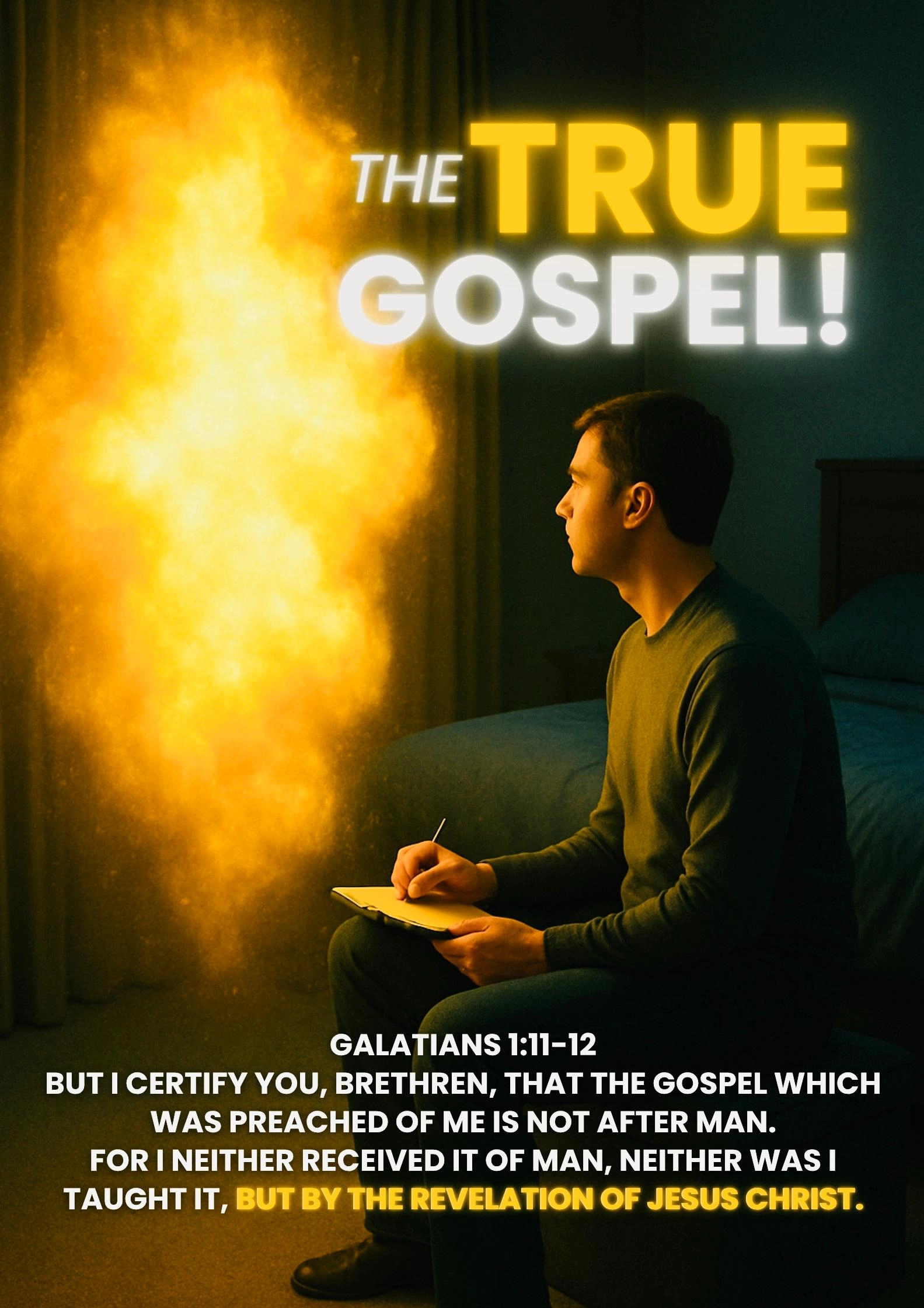
Within mainstream Christianity, the term gospel is commonly used to describe the four canonical accounts of Yeshua’s earthly ministry, Matthew, Mark, Luke, and John. While these writings are invaluable historical and theological witnesses, they were authored decades after the apostolic era and formally canonized centuries later. When the Apostle Paul spoke of the Gospel, he was not referring to these texts as a compiled canon, nor to written accounts at all. He spoke of a revealed message, not one derived from human transmission or tradition (Galatians 1:11–12).
This post contends that the true Gospel proclaimed by the apostles is best understood as the Gospel of Reconciliation, the divine restoration of direct relationship between THE LORD GOD and mankind.
I. The Human Condition: Separation and Spiritual Death
The theological problem addressed by the Gospel originates in Genesis 3. Through disobedience, mankind fell under divine curse and was expelled from the Garden of God, severed from His immediate presence. This separation was not merely spatial or symbolic; it was relational and spiritual.
Notably, after the expulsion, Scripture records no further instance of Adam and Eve hearing the voice of THE LORD GOD directly. As in human relationships, the breakdown of communication signals the rupture of fellowship. This silence marks the beginning of what Scripture later identifies as spiritual death, a state in which humanity is alive biologically yet cut off from divine communion.
Those who are spiritually dead cannot hear the voice of God, cannot know Him personally, and cannot receive truth directly from Him. Instead, they rely on secondary sources, tradition, teachers, institutions, and texts, to form their understanding of God. This condition leaves mankind vulnerable to deception, despair, and self-reliance, all of which are consequences of separation from THE LORD GOD.
II. The Meaning of “Gospel”:
The Announcement of Restoration
The word gospel derives from the Old English godspel, meaning “god-story,” which was used by the translators of the King James Bible to render the Greek terms euangelion (good news) and euangelizomai (to proclaim good news). The Gospel, therefore, is not merely information about God but an announcement of divine action.
So what, precisely, is the Good News?
The Good News is that THE LORD GOD has acted decisively to restore direct relationship with mankind, undoing the curse of separation introduced in Genesis 3. This restoration returns humanity to the kind of fellowship Adam and Eve experienced in Genesis 2, prior to the fall.
Paul articulates this clearly:
2 Corinthians 5:19–21 (KJV)
“To wit, that God was in Christ, reconciling the world unto himself… and hath committed unto us the word of reconciliation.”
Thus, the Gospel is properly named the Gospel of Reconciliation. Without reconciliation, there is no Good News, only religious instruction and moral exhortation.
III. Reconciliation and the New Covenant
Reconciliation is not symbolic; it is relational and experiential. Under the new covenant, THE LORD GOD promises not merely forgiveness of sins but direct knowledge of Himself.
Hebrews 8:10–12 (KJV) declares that God will write His laws upon the hearts and minds of His people and that “they shall all know me, from the least to the greatest.”
This promise abolishes the necessity of human intermediaries. Unlike the old covenant—where Moses served as mediator because the people feared direct communication with God (Exodus 20:19)—the new covenant establishes a radically different arrangement: God Himself teaches His people through the Spirit of Truth.
Yeshua affirmed this repeatedly:
- John 6:45 — “They shall be all taught of God.”
- John 16:13 — “When he, the Spirit of truth, is come, he will guide you into all truth.”
To be reconciled, therefore, is to be restored to a state in which one hears God’s voice, is taught by Him, and lives in ongoing communion with Him.
IV. The Error of Religious Mediation
A central obstacle to obedience to the Gospel is the reintroduction of human intermediaries. Just as the scribes and Pharisees “sat in Moses’ seat” (Matthew 23:2), many modern religious leaders have positioned themselves as necessary mediators between God and man.
This arrangement directly contradicts the new covenant. By replacing the Spirit of Truth with institutional authority, religious systems deprive believers of the very reconciliation the Gospel proclaims. As a result, many form deep relationships with pastors, denominations, and traditions, yet remain unreconciled to THE LORD GOD Himself.
Those who belong to the Kingdom of God share a singular testimony: they hear His voice and are taught by Him. Where this testimony is absent, reconciliation has not occurred, regardless of religious devotion or doctrinal knowledge.
V. Obedience to the Gospel and Final Judgment
Scripture is unequivocal: salvation is inseparable from reconciliation, and reconciliation is inseparable from knowing God personally.
2 Thessalonians 1:7–10 (KJV) warns of judgment upon those “that know not God, and that obey not the gospel of our Lord Jesus Christ.” Ignorance of God is not excused by religious participation; it is evidence of disobedience to the Gospel.
Paul himself testified that the Gospel he preached was not received from men nor taught by human instruction, but came by revelation of Jesus Christ (Galatians 1:11–12). This remains the standard for the Gospel today.
Conclusion
The true Gospel is not a collection of texts, rituals, or doctrines mediated by religious authorities. It is the divine proclamation that THE LORD GOD has reconciled the world to Himself and now calls all people into direct relationship with Him.
To obey the Gospel is to respond to that call, to hear His voice, be taught by His Spirit, and live reconciled to God. Where reconciliation is absent, there is no salvation. Where revelation is replaced by religion, the Gospel has been obscured.
The Gospel of Reconciliation remains the dividing line between life and death, truth and deception, the Kingdom of God and the kingdoms of men.
Read The Next Article: